🚗 Renault Clio 4 Tire Pressure: Complete Guide (Values, Sensor, Warning Light)
- Recommended pressure for a Clio 4 ranges between 2.3 and 2.7 bar (33–39 PSI) depending on the load, the specific version (including the RS), and tire size.
- The tire pressure warning light illuminates as soon as a pressure discrepancy is detected by the TPMS sensor mounted on each wheel.
- To reset the system, use the SET TPW button on the dashboard after inflating all four tires (and the spare tire, if equipped) to the correct values.
- A tire under-inflated by just 0.3 bar (approx. 4 PSI) significantly increases wear and fuel consumption.
- Depending on the trim level and year, the Clio 4 comes with either a space-saver spare tire or a puncture repair kit.
Are you looking for your Renault Clio 4 tire pressure because a warning light just came on, or simply before a long trip? The quick answer: between 2.3 and 2.7 bar (33–39 PSI) when cold, depending on the version, the load, and the tire size fitted (e.g., 185/65 R15, 195/55 R16, or 205/40 R17 on the RS). You can find these values on the sticker located inside the fuel filler flap or on the driver-side door pillar. These values often differ between the front and rear tires. This guide provides the exact pressures by engine type, the inflation procedure, how the TPMS sensor works, how to turn off the warning light using the SET TPW button, and answers to the most frequent questions regarding Clio 4 tires: size, cost, spare tires, and flat tire scenarios.
Clio 4 Tire Pressure: Recommended Values by Version
Renault Clio 4 tire pressure is not a one-size-fits-all value: it depends on the rim diameter, the vehicle load, and the specific model version. For standard petrol and diesel engines (dCi 90, TCe 90, TCe 120) fitted with 185/65 R15 or 195/55 R16 tires, the factory pressure is generally around 2.3 bar (33 PSI) at the front and 2.2 bar (32 PSI) at the rear under normal load (up to 3 occupants). This increases to 2.5 bar (36 PSI) at the front and 2.7 bar (39 PSI) at the rear when fully loaded (5 occupants + luggage). These differences account for weight distribution: the more the car is loaded, the more pressure the rear tires need to compensate for the weight.
On the Clio 4 RS, which uses 205/40 R17 or 205/45 R17 depending on the series (Trophy, Cup), the recommended pressure is higher to maintain the chassis’s sporty handling: generally expect around 2.3 bar (33 PSI) at the front and 2.1 bar (30 PSI) at the rear when cold. This configuration is optimized for road use rather than track use, where values might be adjusted slightly higher.
The golden rule: never rely on a generic figure found online without checking your own vehicle’s sticker. Two Clio 4s from the same year may have different recommendations depending on the original or replacement tire size. The manufacturer’s sticker, located in the fuel flap or on the driver-side door pillar, remains the most reliable source and accounts for different load capacities (2, 3, or 5 occupants).
Where to Find the Sticker and How to Read the Values
The pressure sticker is your ultimate reference for determining the correct tire pressure for your Clio 4. It is presented as a table crossing two criteria: the tire size fitted (as several sizes may equip the same model depending on the trim) and the vehicle’s load level. On the Clio 4, this sticker is most commonly placed inside the fuel filler flap, making it easy to consult without opening the door every time you refuel.
The table typically distinguishes two columns: one for “normal” load (up to 3 people on board, no heavy cargo) and one for “maximum” load (5 people or a full trunk). It also specifies if a specific pressure should be applied during prolonged high-speed driving, a common mention for motorway use.
If the sticker has disappeared or is unreadable, please note that the vehicle registration document does not list tire pressure. You should refer to the Renault owner’s manual (located in the glovebox) or, if unavailable, the generic values by tire size provided by the manufacturer. For 195/55 R16 tires, for example, the standard recommendation is around 2.3 bar (33 PSI) front and 2.2 bar (32 PSI) rear under normal load. If in doubt, a check by a professional is the safest way to avoid prolonged under-inflation, which causes irregular wear and increased fuel consumption.
How to Correctly Inflate Your Clio 4 Tires
Inflation should always be done when cold—meaning before driving or after a trip of less than 2 km at low speed. This is because the heat generated by driving artificially increases the measured pressure, leading to an inaccurate setting. If you must check them while warm (if the tires have already traveled several kilometers), you should add approximately 0.2 to 0.3 bar (approx. 3–4 PSI) to the recommended values to compensate.
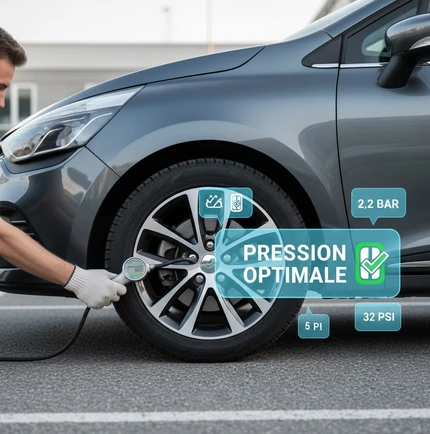
The practical procedure: remove the valve cap, press the pressure gauge nozzle firmly onto the valve to prevent air leaks during measurement, read the displayed pressure, and adjust by adding or releasing air until you reach the target value. Most service stations are equipped with automatic compressors where you can set the desired pressure before starting the inflation—a very convenient option if you do not own a personal pressure gauge.
A portable digital pressure gauge is an inexpensive tool that allows you to check your own pressure at home. This is particularly useful for monthly checks, which is the generally recommended frequency to limit the irregular wear and increased consumption caused by progressive under-inflation (tires naturally lose a little pressure every month due to rubber permeability).
Don’t forget the spare tire if your vehicle is equipped with one: its pressure is often higher (around 4.2 bar or 61 PSI for a space-saver), and it should also be checked regularly even if it is rarely used.
Clio 4 Tire Pressure Sensor: How TPMS Works
The Clio 4 is equipped with a Tire Pressure Monitoring System (TPMS), which exists in two forms depending on the version and year: a direct system, featuring an electronic sensor integrated into each wheel that measures pressure and temperature in real-time, and an indirect system, which is simpler and deduces a pressure loss by comparing the rotation speed of the wheels via the existing ABS sensors (an under-inflated tire rotates slightly faster than a properly inflated one of the same diameter).
On Clio 4 models equipped with the indirect system, there is no physical pressure sensor inside the wheels. This is why a simple reset via the SET TPW button after inflation is sufficient to recalibrate the system without needing to replace any parts. On newer or higher-trim versions equipped with the direct system, an electronic sensor is screwed onto each wheel valve and transmits information via radio frequency to the ECU. These sensors have an internal battery with a lifespan typically between 7 and 10 years; after this, replacement by a professional (including reprogramming) becomes necessary if the warning light stays on despite correct pressure.
The cost of a Clio 4 tire pressure sensor varies by version and supplier, but it is a budget item to anticipate in case of failure, especially if all four sensors need to be changed at the same time to ensure uniform wear.
Clio 4 Tire Pressure Warning Light: Why It Lights Up and What to Do
The tire pressure warning light, represented by a tire pictogram with an exclamation mark, illuminates on the dashboard in several distinct situations that you should be able to differentiate before acting.
The most frequent case is a real pressure discrepancy detected in one or more tires: a slow leak due to a slightly porous valve, a temperature variation (winter cold can drop pressure by about 0.1 bar/1.5 PSI for every 10°C drop), or a slow puncture not visible to the naked eye. In this case, checking the pressure and inflating to the correct values is usually enough to turn off the light after a reset.
Another common case on Clio 4 models with indirect systems: the light remains on after simply fitting new tires or rotating the wheels, even when the pressure is correct, simply because the system has not yet been recalibrated. This is not a mechanical anomaly but a missed reset.
Finally, a light that flashes and then stays solid, or one that turns on repeatedly despite correct pressure readings, may signal a faulty sensor (on direct systems) or a larger ECU issue, requiring a diagnostic check at a garage. You should never ignore this light for long: driving with incorrect pressure for several weeks accelerates irregular tread wear and, in extreme cases of significant under-inflation, can lead to tire overheating at high speeds.
How to Reset the Clio 4 Tire Pressure Light (SET TPW Procedure)
To turn off the tire pressure warning light on a Clio 4, the standard procedure involves the SET TPW (Tyre Pressure Warning) button, generally located on the center console between the front seats or under the gear lever depending on the trim.
Step by step: Start by checking and correcting the pressure of all four tires according to the manufacturer’s sticker, with the engine off and tires cold. Once inflation is complete, turn on the ignition without starting the engine (the “ignition on” position). Press and hold the SET TPW button until the warning light flashes three times on the dashboard, signaling that the reset has been accepted by the ECU. Release the button and start the car normally: the light should turn off after a few minutes of driving, allowing the system time to recalibrate the pressure reference for each wheel.
If the light persists after this, several things should be checked: incorrect pressure on one of the four tires (even a minimal discrepancy of 0.1–0.2 bar/2–3 PSI is enough to prevent the light from turning off), a wheel that was poorly recalibrated after a recent change, or a faulty TPMS sensor on direct-system versions. In the latter case, an electronic diagnostic at a Renault professional or a specialized garage can identify the specific wheel causing the issue before any sensor replacement.
Clio 4 Tire Sizes, Spare Tires, and Budget
The Clio 4 was marketed with several tire sizes depending on the trim and rim diameter: 185/65 R15 on entry and mid-range versions, 195/55 R16 on intermediate and higher trims, and 205/40 R17 or 205/45 R17 on the Clio 4 RS. It is essential to respect the original size (or an approved equivalent) when replacing tires, as a change in dimension modifies the rolling circumference and can distort the readings of the indirect TPMS system, which relies on rotation speed.
Regarding the spare tire, depending on the year and trim, the Clio 4 offers either a space-saver (smaller, for temporary use limited to low speeds) or a simple puncture repair kit (sealant + compressor). Some high-end versions have neither to save weight and trunk space. It is recommended to check what equipment is actually present under the trunk floor when purchasing the vehicle, especially if buying used.
The price of a replacement tire for a Clio 4 varies significantly depending on the brand (premium, mid-range, budget) and the size: 185/65 R15 tires are generally the cheapest due to their wide availability, while the more specific 205/40 R17 tires for the RS cost considerably more per unit. In the event of a flat tire, a repair is only possible if the puncture is located in the central tread area and the sidewall is undamaged; otherwise, tire replacement is mandatory for safety reasons.
What is the correct pressure for Clio 4 front tires?
It is generally between 2.2 and 2.5 bar (32–36 PSI) when cold depending on the load and tire size, but you must always check the sticker inside your vehicle’s fuel flap for the exact value.
How do I turn off the tire pressure warning light on a Clio 4?
Inflate all four tires to the recommended values, turn on the ignition without starting the engine, then press and hold the SET TPW button until the light flashes three times before starting normally.
How do I reset the Clio 4 tire pressure after changing a wheel?
After any new tire installation or wheel rotation, perform the same SET TPW procedure once pressures are verified; otherwise, the system may continue to display an unjustified alert.
What is the tire pressure for the Clio 4 RS?
Around 2.3 bar (33 PSI) at the front and 2.1 bar (30 PSI) at the rear when cold for road use; adjust slightly according to the load and the manufacturer’s sticker specific to this version.
What tire size does a Clio 4 use?
Depending on the trim, the Clio 4 is fitted with 185/65 R15, 195/55 R16, or for the RS, 205/40 R17 or 205/45 R17.
How much does a Clio 4 tire pressure sensor cost?
The price varies depending on the system type (indirect without a physical sensor, or direct with a TPMS sensor per wheel) and the supplier; it is best to request a quote from a garage for an accurate current price.
Does the Clio 4 have a spare tire?
This depends on the trim and year: some versions have a space-saver, others have a simple puncture repair kit, and it is advised to check the actual equipment under the trunk floor.
What should I do in case of a flat tire on a Clio 4?
If the puncture is in the tread and the sidewall is intact, a repair is possible; otherwise, the tire must be replaced for safety reasons.
Sources
- Clio 4 Tire Pressure: Recommended Values and Resetting
- Tire Pressure Chart for your Renault Clio 4 | PressionPneu.com
- Reset SET TPW Clio 4 Tire Pressure Warning Light

À découvrir

Car Rental Trends: The 4th Industrial Revolution
Discover how Industry 4.0 is transforming automotive distribution, electrification, and car rentals. Explore the key challenges and future outlook.

Leapmotor D19: Electric SUV with 1,000 km Range
October 31, 2026
Peugeot e-208 GTi 2026: Price, Range & Performance
October 30, 2026