

Driving License Withdrawal for Speeding: What to Do Immediately?
- For speeds exceeding the limit by 40 km/h, law enforcement will perform an immediate retention of your license, valid for a maximum of 72 hours.
- Point deductions range from 1 to 6 depending on the severity; an administrative suspension can last up to 1 year.
- New drivers on probationary licenses risk full license invalidation upon losing their initial point capital.
- Contesting the fine or attending a court hearing can sometimes worsen the sanction with a judicial suspension or total cancellation.
- The first 72 hours after retention are critical: it is the time to organize your travel and, if necessary, plan for a car rental once your situation is resolved.
A speeding violation of 40 km/h or more triggers an immediate license retention at the scene: officers confiscate the document, and the driver must continue without it. This retention lasts a maximum of 72 hours before a Prefect decides on a potential administrative suspension that can extend up to one year. Below this threshold, the penalty is usually limited to a fine and a deduction of points, without physical confiscation of the license. What matters in the following hours is distinguishing between retention, suspension, and cancellation—three different mechanisms with very different consequences—and organizing your upcoming travel without delay, especially if your professional activity or a current trip depends on driving.
Retention, Suspension, and Cancellation: Do Not Confuse Them
Three terms consistently appear during interactions with law enforcement and administration, and confusing them often leads to poor planning regarding timelines.
Retention is the first step, purely material: an officer confiscates your license on the spot, usually during a speeding violation equal to or greater than 40 km/h above the limit. It lasts a maximum of 72 hours while the departmental Prefect reviews the case. During this period, the driver can no longer legally get behind the wheel, even for short trips.
Suspension is an administrative decision made by the Prefect, or a judicial one if the case is brought before a court. It extends the driving ban beyond the initial 72-hour retention for a duration that depends on the severity of the offense, the driver’s history, and the context (repeat offenses, or presence of other infractions like alcohol or drugs). An administrative suspension can last several months, while a judicial suspension can last up to one year, or even three years in cases of aggravating circumstances judged in court.
Cancellation is the most severe sanction: it does not concern a simple, isolated speeding offense but generally applies in cases of repeat offenses, a probationary license that has run out of points, or a specific judicial decision. Unlike a suspension, cancellation requires you to retake the entire licensing process, including both the theory and practical driving tests, after a period set by a judge.
Thresholds for Each Type of Penalty
The scale of penalties depends directly on the extent of the speeding violation, measured after deducting the technical error margin of the radar.
For a violation of less than 20 km/h, the penalty remains a fine with a one-point deduction, without confiscation of the license. Between 20 and 30 km/h, the point deduction increases to two, still without immediate retention. Between 30 and 40 km/h, the fine is heavier, with a three-point deduction, and an administrative withdrawal of the license becomes possible depending on the officers’ assessment and the context of the infraction.
Crossing the 40 km/h over the limit threshold radically changes the situation: the fine moves to class 4 or 5, the deduction reaches four points, and most importantly, immediate retention of the license becomes systematic on the spot. Between 40 and 50 km/h, the fine may be accompanied by a suspension of up to three years if the case is referred to a court rather than being handled as a simple fixed fine.
Beyond a 50 km/h violation, the offense becomes a criminal offense (délit) rather than a simple violation: mandatory appearance before a criminal court, a six-point deduction, a suspension that can reach three years, or even cancellation in the event of a repeat offense within three years. The vehicle may also be immobilized or even confiscated in the most serious cases.
What to Do in the 72 Hours Following Retention
The 72-hour retention period is a short but decisive window during which several concrete steps can limit the impact of the sanction.
First, check the receipt provided by law enforcement: it mentions the date and time of retention, the reasons, and serves as temporary proof. This document does not replace your license for driving but serves as evidence of your situation in case of an administrative check.
Next, organize your daily travel without delay. Without a license, it is impossible to drive your own vehicle: you must find an immediate alternative, whether it is a relative available to handle essential trips, public transport, or, for those on professional business trips or traveling, hiring a driver or postponing planned trips. A driver on a tourist or professional trip whose license is retained must particularly anticipate the rest of their itinerary, as they will be unable to drive a personal vehicle or sign a car rental agreement until the situation is clarified.
Finally, quickly seek information regarding the next steps of the procedure from the prefecture or a lawyer specializing in road law if the speeding exceeds 40 km/h. The decision regarding administrative suspension usually arrives by mail in the days following retention, stating the duration and the possible methods of appeal.
Contesting a Suspension or a Fine
Contesting is not always the right strategy, but in certain specific cases, it can reduce or cancel the penalty.
Contests most often focus on the reliability of the measurement: radar certification, unapplied error margins, or questionable control conditions (lack of proper signage, poorly positioned mobile radar). A road law attorney can examine the police report and identify procedural errors capable of canceling the fine.
However, be careful: contesting a fixed fine automatically refers the case to a police or criminal court, which exposes you to a potentially heavier penalty than the initial fine if the judge confirms the infraction. This option is mostly justified when there are solid factual elements questioning the measurement itself, rather than a simple desire to buy time.
For an administrative suspension decided by the Prefect, an informal appeal (recours gracieux) or an appeal before the administrative court is possible, but deadlines are short and chances of success are limited unless there is a manifest procedural error. In practice, most drivers choose to accept the sanction and organize their lives for the duration of the suspension rather than engaging in a long and uncertain legal procedure.
The Specific Case of New Drivers
Holders of a probationary license—generally during the first three years after obtaining it (two years with supervised driving)—have a reduced point capital, usually set at six points in the first year, with an annual increase until the full capital is reached.
This reduced capital makes new drivers particularly vulnerable to significant speeding violations. A four-point deduction for a violation between 40 and 50 km/h can, on its own or combined with a previous infraction, entirely deplete the point capital and lead to license invalidation. This is distinct from judicial cancellation but just as restrictive: the driver receives a “48SI” letter informing them that they must retake the driving tests after a waiting period, generally six months, which increases to one year in the case of a new invalidation.
Furthermore, a new driver on a probationary period convicted of speeding by at least 40 km/h may be required to attend a road safety awareness course in addition to the primary sanction. This period of vulnerability calls for increased vigilance, especially on highways where high cruising speeds make exceeding thresholds more frequent than in urban areas.
Consequences on Highways and During Tourist Trips
Highways account for a significant portion of speeding violations that result in license withdrawal, due to naturally higher traffic speeds and the presence of many fixed and mobile radars on these routes.
Exceeding the limit by 160 km/h on a section limited to 130 km/h, for example, far exceeds the 40 km/h threshold and triggers immediate retention if caught. Long-distance trips, often undertaken by professional travelers or tourists, are therefore particularly exposed to this type of sanction when speed vigilance slips during a monotonous drive.
For a tourist or a professional on a mission whose license is retained during a stay, the situation quickly becomes complicated: it is impossible to continue the journey with their own vehicle or a rental vehicle as long as the retention is in effect. This can compromise the remainder of a planned itinerary, a return to the starting point, or professional appointments. In this context, anticipating an alternative mobility solution—public transport, a private driver, or rescheduling trips—becomes an immediate necessity rather than a luxury.
At what speed threshold is a license withdrawn for speeding?
Immediate license retention generally occurs when exceeding the speed limit by 40 km/h. Below this threshold, the penalty is usually limited to a fine and point deduction.
How long does a license withdrawal for speeding last?
The initial retention lasts a maximum of 72 hours. This can be followed by an administrative or judicial suspension, with a duration varying from a few months to three years depending on the severity of the facts and the driver’s history.
How many points are deducted for a speeding violation of 40 km/h?
A speeding violation between 40 and 50 km/h generally results in a four-point deduction, in addition to the fine and the risk of immediate retention.
What is the difference between license suspension and cancellation?
A suspension temporarily prohibits driving for a set period, after which the license becomes valid again. Cancellation requires you to retake the entire theory and practical driving tests after a period set by a judge.
Are new drivers at higher risk in cases of speeding?
Yes: the reduced point capital on a probationary license makes invalidation faster, and a significant speeding violation can wipe out the entire point balance in a single infraction.
Can you drive during the 72-hour license retention period?
No, driving is strictly prohibited during retention, even for short trips. The receipt provided by law enforcement is not an authorization to drive.
Are speeding violations on highways punished more severely?
The penalty depends solely on the extent of the speeding, not the type of road. However, higher traffic speeds on highways increase the risk of crossing the 40 km/h threshold that triggers immediate retention.
Can you contest a license withdrawal for speeding?
Yes, in the event of a procedural error or doubt regarding the reliability of the radar check, but contesting the fine refers the matter to a court, with the risk of a heavier penalty if the infraction is confirmed.
Sources
- Point scale for deductions by infraction – Service-Public.fr
- Speeding: scale of sanctions – LegiPermis
- License withdrawal for speeding: thresholds – LegiPermis
- Speeding between 40 and 50 km/h – LegiPermis
- Exceeding the limit by more than 40 km/h: what are the risks – Car-Avocat
- Speeding and license suspension: complete scale – AAAEP

À découvrir
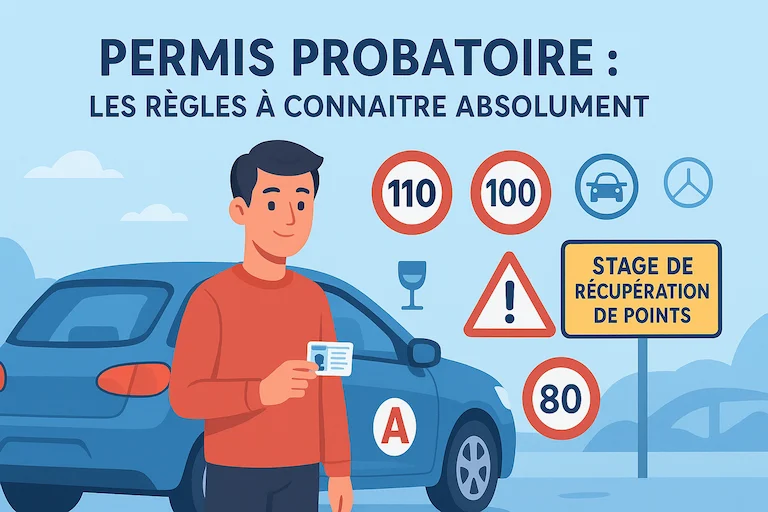
Probationary License: Essential Rules and Restrictions
Learn the rules for probationary licenses in France and Quebec: duration, points, speed limits, alcohol limits, and car rental requirements.

Leapmotor D19: Electric SUV with 1,000 km Range
October 31, 2026
🚗Car Accessories: 2026 Guide & Top Essentials
November 7, 2026