Probationary License: Everything You Need to Know Before Getting Behind the Wheel
- A probationary license applies from the moment you first obtain your license (or after a judicial cancellation), for a duration of 2 to 3 years in France and 24 months in Quebec.
- The point capital is reduced: 6 points out of 12 in France; Quebec has a much lower tolerance threshold before a file review is triggered.
- Alcohol tolerance is nearly zero: 0.2 g/L in France, and zero tolerance in Quebec for probationary license holders.
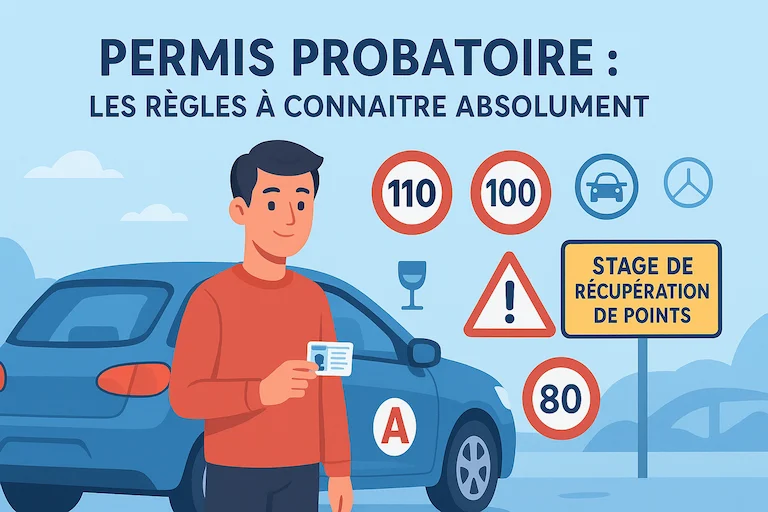
- Specific speed limits apply in France (110/100/80 km/h depending on the road type), while Quebec imposes reinforced restrictions regarding night driving and passenger numbers.
- Renting a car with a probationary license is possible, but some rental companies apply young driver surcharges or restrictions on age/license seniority.
Have you just passed your driving test, or are you assisting a new driver who is planning to rent a vehicle for a trip? The probationary license operates under a stricter framework than a standard license: fewer points, lower blood alcohol limits, reduced speed limits, and sometimes restrictions on passengers or driving hours. These rules differ depending on whether you are in France or Quebec, where the SAAQ (Société de l’assurance automobile du Québec) applies its own system. This article details, country by country, the duration of the probationary period, the number of available points, alcohol thresholds, speed limits, and specific conditions to follow—including what you need to know before renting a car with this type of license.
What exactly is a probationary license?
A probationary license is not a separate category of license; it is a temporary status attached to a Category B (car) license upon initial issuance, or after returning to driving following an invalidation or judicial cancellation. In practical terms, this means the driver holds a valid driver’s license, but it comes with a reduced point capital and reinforced traffic rules for a defined period.
In France, this status lasts for three years after obtaining the license, reduced to two years if the candidate completed “conduite accompagnée” (guided driving) or supervised driving. In Quebec, the SAAQ refers to it as a “new driver” period and applies a 24-month probationary period, regardless of the age at which the license was obtained.
One important point that is often misunderstood: if you already hold a standard Category B license and subsequently pass a motorcycle test (such as Category A2), the probationary regime does not apply to this new category, as you are no longer considered a novice driver in the strict sense. The rule primarily targets people driving for the very first time or those starting from scratch after a long suspension.
Probationary license duration: France and Quebec
The exact duration of the probationary period depends directly on the training method followed and the issuing country.
In France, there are two scenarios. Candidates from the classic route (traditional driving school, without accompaniment) remain in the probationary period for three years. Those who completed guided driving starting at age 15, or supervised driving, see this period reduced to two years—a way for the state to reward longer driving experience prior to the exam.
In Quebec, the process is different: after passing the theoretical and practical exams, the new driver receives a probationary license valid for 24 months. This timeframe is not adjustable based on the training path, but it can be extended in the event of an infraction or the accumulation of demerit points, which delays access to a full driver’s license.
In both systems, the logic remains the same: the more flawless your driving is during this period, the faster and more smoothly you will transition to a full license without additional administrative complications.
Available points during the probationary period
The management of the point capital is undoubtedly the best-known, and often most misunderstood, rule of the probationary license.
In France, a standard license starts with 12 points. A probationary license, however, starts with only 6 points. This capital then increases progressively each year without an infraction: +2 points per year for a license obtained through the classic route (resulting in 6, 8, 10, and then 12 points after three years), or +3 points per year for guided driving (6, 9, and then 12 points after two years). Conversely, losing points has heavier consequences: a deduction of 3 points or more during the probationary period automatically triggers a restriction letter or even a mandatory road safety course.
In Quebec, the system works on the principle of demerit points rather than a decreasing capital. A probationary license holder accumulates points for each infraction (speeding, running a red light, etc.), and a threshold much lower than that of experienced drivers is enough to trigger a file review, which can lead to license suspension. This lower threshold reflects the SAAQ’s desire to more quickly penalize risky behavior among new drivers, who are statistically more involved in accidents during their first years of driving.
Alcohol behind the wheel: Zero tolerance (or almost)
This is one of the strictest rules and one of the most frequently searched by new drivers and their families.
In France, the authorized blood alcohol concentration (BAC) for a driver in a probationary period is set at 0.2 grams of alcohol per liter of blood, compared to 0.5 g/L for a standard license. In practice, this means nearly zero tolerance: a single drink can be enough to exceed this threshold depending on body mass, gender, or absorption rate. Exceeding this limit results in point deductions, fines, and even license suspension in cases of recidivism or high levels.
In Quebec, the rule is even more radical: the SAAQ applies zero alcohol tolerance to all holders of a learner’s permit or a probationary license, with no age-related exceptions. In other words, driving after consuming any amount of alcohol constitutes an offense, regardless of the measured BAC. This rule is additional to, and does not replace, the criminal penalties provided by the Criminal Code for impaired driving.
For a tourist or a young driver planning to rent a vehicle during a stay, this rule deserves special attention: roadside checks do not distinguish between residents and visitors, and ignorance of local rules is never a mitigating circumstance.
Specific speed limits for probationary licenses (France)
In France, a probationary license comes with lower speed limits compared to a standard license during the first three years (or two, in the case of guided driving):
On highways (autoroutes), the maximum authorized speed is 110 km/h instead of 130 km/h. On dual carriageways (roads with two lanes separated by a central reservation), it is 100 km/h instead of 110 km/h. On other roads outside urban areas, the limit remains set at 80 km/h, identical to the standard license since the 2018 general reduction. In urban areas (agglomérations), no difference is applied: 50 km/h remains the standard for all drivers.
These reduced caps are not trivial: failing to respect these specific thresholds is penalized exactly like a standard speeding offense, with point deductions proportional to the recorded excess. However, because the available point capital is lower, the relative impact is significantly heavier for a probationary driver.
In Quebec, there is no distinct speed scale for new drivers: the general road network limits apply to everyone, but the demerit points accumulated during a speeding offense weigh proportionally more on a probationary file due to the lower review threshold mentioned above.
Passengers, night driving, and phone usage
Some probationary license restrictions concern the context of driving rather than the driving itself: who is on board, at what time, and with what equipment.
In Quebec, new drivers holding a learner’s or probationary license are subject to reinforced supervision at night, a period that is statistically more accident-prone for inexperienced drivers. Authorities strongly recommend avoiding non-essential night trips during the first months of driving, particularly after midnight, when vigilance and visibility are at their lowest. Furthermore, the use of a cell phone, including hands-free mode, is prohibited for all probationary license holders in Quebec—a rule stricter than that applied to regular license holders, who may use approved hands-free devices.
In France, no specific legal restriction limits the number of passengers or driving hours for a probationary license: the general rules of the Highway Code (handheld phone use is prohibited for everyone, seatbelts are mandatory) apply in the same way as to standard license holders. The prudence recommended for young drivers, especially after an evening out, is more a matter of awareness than a separate legal obligation.
Sanctions in case of an infraction during the probationary period
The consequences of an infraction committed during the probationary period go beyond a simple fine, with direct effects on the duration of the probationary status itself.
In France, a deduction of 3 points or more systematically results in a registered letter informing the driver of the reduction in their capital, accompanied in some cases by the obligation to attend a road safety awareness course within a set timeframe, failing which the license may be automatically suspended. If the point capital reaches zero, the license is invalidated, and the driver must retake all exams—both theoretical and practical—after a waiting period.
In Quebec, accumulating demerit points beyond the threshold set for probationary drivers triggers a file review by the SAAQ, which can result in a license suspension. In some cases, particularly regarding recent repeat offenses, the probationary period itself may be extended, delaying access to a regular license. A serious offense, such as driving while impaired despite zero tolerance, also exposes the driver to criminal penalties distinct from the administrative sanctions related to the license.
In both systems, the message is the same: the margin of error tolerated during the probationary period is intentionally reduced because accident statistics show a high representation of young drivers during their first years on the road.
Renting a car with a probationary license
For a tourist or a young driver on the move, one question often arises: is a probationary license accepted by car rental companies? The answer is yes in the vast majority of cases, but there are a few nuances to know before booking.
First, a probationary license is a fully valid driver’s license: no rental company can refuse a rental solely because it is a probationary license rather than a standard one. However, most agencies apply criteria related to age and license seniority, regardless of its probationary status. A driver under 25, or someone who has held their license for less than one or two years depending on the rental company, will often be subject to a young driver surcharge, sometimes combined with a higher damage excess (deductible) in the event of a claim.
Second, certain vehicle categories—high-end models, large utility vehicles, or luxury cars—are frequently excluded from rental for drivers who have recently obtained their license, regardless of their probationary status, simply due to the estimated lack of driving experience.
Finally, it is essential to keep in mind that probationary license rules (alcohol, speed) apply wherever you drive, including when using a rental vehicle, and sometimes even abroad if the driver remains subject to the regulations of their country of origin or the country being visited. Therefore, before any trip involving a car rental, it is recommended to check both the rental company’s terms and the local regulations applicable to novice drivers.
How long does a probationary license last in France?
Three years for a license obtained through the classic route, reduced to two years in the case of guided or supervised driving before the exam.
How long does a probationary license last in Quebec?
The SAAQ sets a 24-month probationary period, which can be extended in the event of an infraction or the accumulation of demerit points.
What is the authorized blood alcohol limit with a probationary license?
In France, the limit is 0.2 g/L of blood. In Quebec, the SAAQ applies zero tolerance for all holders of a learner’s or probationary license.
What are the maximum authorized speeds with a probationary license in France?
110 km/h on highways, 100 km/h on dual carriageways, 80 km/h on other roads, and 50 km/h in urban areas.
How many points do you have with a probationary license in France?
The starting capital is 6 points out of 12, with a progressive increase each year without an infraction, up to 12 points after two or three years depending on the route taken.
Can you rent a car with a probationary license?
Yes, a probationary license is a valid license accepted by rental companies, but age and license seniority may result in a young driver surcharge or exclusion from certain vehicle categories.
Are there restrictions on passengers with a probationary license?
In France, there is no specific legal restriction on the number of passengers. In Quebec, caution is strongly recommended at night for newly licensed drivers due to the increased risk of accidents during this period.
What happens in the case of a serious infraction during the probationary period?
In France, a significant point deduction can lead to a mandatory course or license invalidation if the capital reaches zero. In Quebec, the probationary period can be extended and the file reviewed by the SAAQ if the demerit point threshold is exceeded.
Sources
- Service-public.fr — What is a probationary driver’s license?
- Mon Petit Permis — Probationary license: duration, points, and specific rules
- Tout Sur Mes Finances — Probationary license: definition, duration, rules
- SAAQ — Driver’s license
- SAAQ — How to re-obtain a probationary license
- Tecnic — Probationary license in Quebec: how does it work?

À découvrir

Car Rental Trends: The 4th Industrial Revolution
Discover how Industry 4.0 is transforming automotive distribution, electrification, and car rentals. Explore the key challenges and future outlook.

🚛 Truck Suspension Problems: Signs, Diagnosis & Solutions
November 6, 2026
2026 Electric Car: How to Reduce Charging Costs
October 30, 2026