
Automotive Distribution and the 4th Industrial Revolution: What are the Implications for Car Rentals?
- The 4th Industrial Revolution is disrupting automotive distribution through connectivity, data, and process automation.
- Electrification requires a complete overhaul of logistics networks: charging stations, battery management, and specialized maintenance.
- Connected vehicles generate data used to personalize rental offers and enable predictive maintenance.
- Partial vehicle autonomy is already changing mobility habits and rental company expectations.
- For travelers, these changes mean more flexibility, digitized agencies, and more modern fleets.
Are you wondering why renting a car today feels nothing like the experience of ten years ago? The answer lies in one term: Industry 4.0. The automobile, born in the heart of the first industrial revolution with the steam engine and later popularized by Henry Ford’s assembly line in 1913, is currently undergoing its fourth major mutation. This time, it isn’t just the factories changing first, but the entire distribution chain: rental agencies, dealerships, and booking platforms. Electrification, connectivity, and automation are reshaping how travelers reserve, pick up, and use a vehicle abroad. This article breaks down these transformations and their concrete impact on the car rental sector.
From Ford’s Assembly Line to the Connected Factory: A Century of Disruption
The automotive industry has always mirrored industrial revolutions. The first, driven by the steam engine and the beginnings of precision mechanics, allowed the emergence of the first motorized prototypes in the late 19th century. The second, powered by electricity and oil as mass energy sources, made mass production possible: before 1913, every vehicle was hand-built in a workshop, reserved for the elite. The assembly line introduced by Ford changed the game by making the car accessible to the masses. The third revolution, defined by electronics and computing, automated factories in the 1970s and 1980s with the first industrial robots.
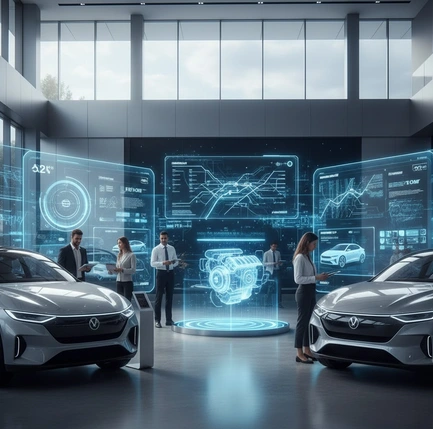
The fourth industrial revolution, the one we are focusing on here, is no longer played out solely in factories but across the entire automotive ecosystem: AI-assisted design, onboard sensors, and digital sales and rental platforms. For distribution, this means that the customer touchpoint—the rental agency, the airport counter, the mobile app—becomes as strategic as the production line itself. The rented vehicle is no longer just a mechanical object; it is a connected terminal that continuously exchanges data with the rental company, the manufacturer, and sometimes the insurer.
Electrification: A New Logistical Challenge for Rental Companies
The rise of electric and hybrid vehicles is reshaping fleet logistics. For a rental agency, managing an electric car is more than just replacing a tank of gas with a battery charge. They must anticipate the vehicle’s actual range based on the season and the planned tourist route, map out available charging stations along the customer’s itinerary, and train staff on different return procedures—such as checking state of charge, provided cables, and recharge time before the next customer.
This challenge is compounded by the need for specialized maintenance: batteries require different monitoring than traditional internal combustion engines, involving regular electronic diagnostics to prevent premature degradation. Rental companies must also rethink the geographic placement of their pick-up points, prioritizing areas where charging infrastructure is dense enough to reassure tourists, who are often unfamiliar with electric vehicles. Some networks are betting on partnerships with charging operators to guarantee easy access, while others still prefer to limit electric offerings to urban, short-term rentals where range is more predictable.
Connected Vehicles and Data: Moving Toward Bespoke Rentals
Onboard connectivity is transforming the relationship between the rental company and its customers. Modern vehicles collect real-time information on mechanical status, fuel or charge levels, location, and even driving style. For rental professionals, this mass of data opens unprecedented possibilities: predicting a breakdown before it happens, optimizing vehicle repositioning between agencies based on tourist demand, or adjusting rates based on actual fleet usage.
For the customer, this connectivity translates into smoother services—vehicle geolocation at the time of pickup, unlocking doors via smartphone, and remote assistance in case of a roadside incident. Booking platforms now integrate this data to offer personalized recommendations: the type of vehicle best suited for the journey or insurance options tailored to the driver’s profile. This personalization directly meets the expectations of well-informed travelers who compare offers online before booking and expect total transparency regarding the condition and features of the rented vehicle.
Autonomy and Assisted Driving: Impact on Travel Habits
While fully autonomous cars remain a distant horizon for the general public, driver-assistance technologies are already widely present in modern rental fleets: adaptive cruise control, automatic emergency braking, and lane-keeping assist. For a tourist driving in a country where they are unfamiliar with the roads or local driving laws, these assistance systems significantly reduce stress and the risks associated with an unknown environment.
This technological evolution also influences how rental companies position their offers. Vehicles equipped with advanced driver-assistance systems (ADAS) are increasingly highlighted as a key selling point, particularly for long-distance trips or mountain driving where driver vigilance is tested. In the long run, the progressive integration of semi-autonomous functions could also modify pricing models, with premium options linked to the level of onboard assistance rather than just the vehicle category.
Digital Distribution: The End of the Traditional Rental Counter?
The fourth industrial revolution is also transforming the point of sale itself. Automotive distribution networks, whether dealerships or rental agencies, must deal with customers who arrive already informed, having compared offers and read online reviews before even stepping through the door. The physical counter isn’t disappearing, but its role is evolving: it is becoming a point for finalization and advice rather than the sole place to discover the offer.
Mobile apps now allow users to book, modify, and cancel a rental without human interaction, track real-time vehicle availability at a specific branch, and sometimes even pick up a car without visiting a counter, thanks to automated kiosks or remote unlocking devices. This digitalization responds to a demand for unprecedented reactivity: a tourist landing late at night at an airport no longer wants to wait in line to collect their vehicle. Players investing in these digital journeys gain a clear competitive advantage over those still tied to manual processes inherited from previous decades.
What These Changes Mean Concretely for the Traveler
For a traveler renting a car abroad, these transformations translate into tangible benefits but also require new types of vigilance. Fleets are being renewed faster, featuring vehicles better equipped with driving assistance and connectivity, which improves comfort and safety on tourist routes often driven in unusual conditions. Booking and returns are becoming faster thanks to digital tools, reducing time spent at agency counters.
On the other hand, it has become essential to carefully check the specifics of the reserved vehicle before departure: the actual range in the case of an electric model, the presence of the promised connected equipment, and the return procedures if the pickup is done via an automated kiosk without staff on-site. Researching the available charging network along the planned route or verifying that the agency offers remote assistance in your language can help avoid unpleasant surprises. These new technologies, when well-understood, offer a smoother rental experience, but they require a slightly different level of preparation than a traditional rental.
What is the 4th Industrial Revolution applied to the automotive industry?
It is the integration of digital technology, connectivity, and automation across the entire automotive chain—from production to distribution—including connected vehicles, electrification, and driver-assistance systems.
How does electrification impact car rentals?
It forces rental companies to rethink logistics: locating stations near charging points, staff training, and managing different maintenance needs and driving ranges based on trip types.
Are rental cars truly connected today?
Many recent models feature sensors that transmit data regarding vehicle status, location, and usage, which rental companies use for maintenance and personalized service offerings.
Can you rent a fully autonomous car?
No, fully autonomous driving is not yet available for general consumer rental; however, advanced driver-assistance systems are already present in many fleet vehicles.
Why are rental agencies digitizing so heavily?
Because customers arrive better informed and expect reactivity and flexibility; digital tools enable booking, modification, and pickup without needing to visit a traditional counter.
How should I prepare for an electric car rental while on vacation?
Check the actual range of the specific model, locate charging stations along your planned route, and inquire about return and charging procedures before you depart.
Is mass production linked to today’s car rental industry?
Yes, the widespread adoption of mass production initiated by Ford in 1913 made automobiles accessible to the masses, laying the groundwork for modern rental fleets.
Sources
- Automotive distribution at the dawn of the 4th Industrial Revolution
- Automobiles and the Industrial Revolution — Culture Auto
- Cars: The invention that revolutionized mobility — Durabilis

À découvrir
Renault Clio 4 Tire Pressure: Values & Resetting Guide
Find the ideal tire pressure for your Renault Clio 4 (33-39 PSI), how to use the TPMS sensor, and how to reset the tire pressure warning light.

Tire Guide: How to Extend Tire Life | Pro Tips
October 29, 2026
Charging an EV: Is it harder than refueling?
October 28, 2026