
Car Rental Documents: The Complete 2026 Checklist
- Three documents are required by all agencies: driver’s license, identity document, and a credit card in the primary driver’s name
- The license must typically have been held for at least 1 year (3 years for certain vehicle categories or young drivers)
- The credit card must be a true credit card (Visa/Mastercard) in the renter’s name; debit or prepaid cards are often rejected
- For peer-to-peer rentals, a written contract and a copy of the vehicle’s insurance are also required
- Sole traders may sometimes need to provide business registration documents (such as a Kbis extract) for professional rentals
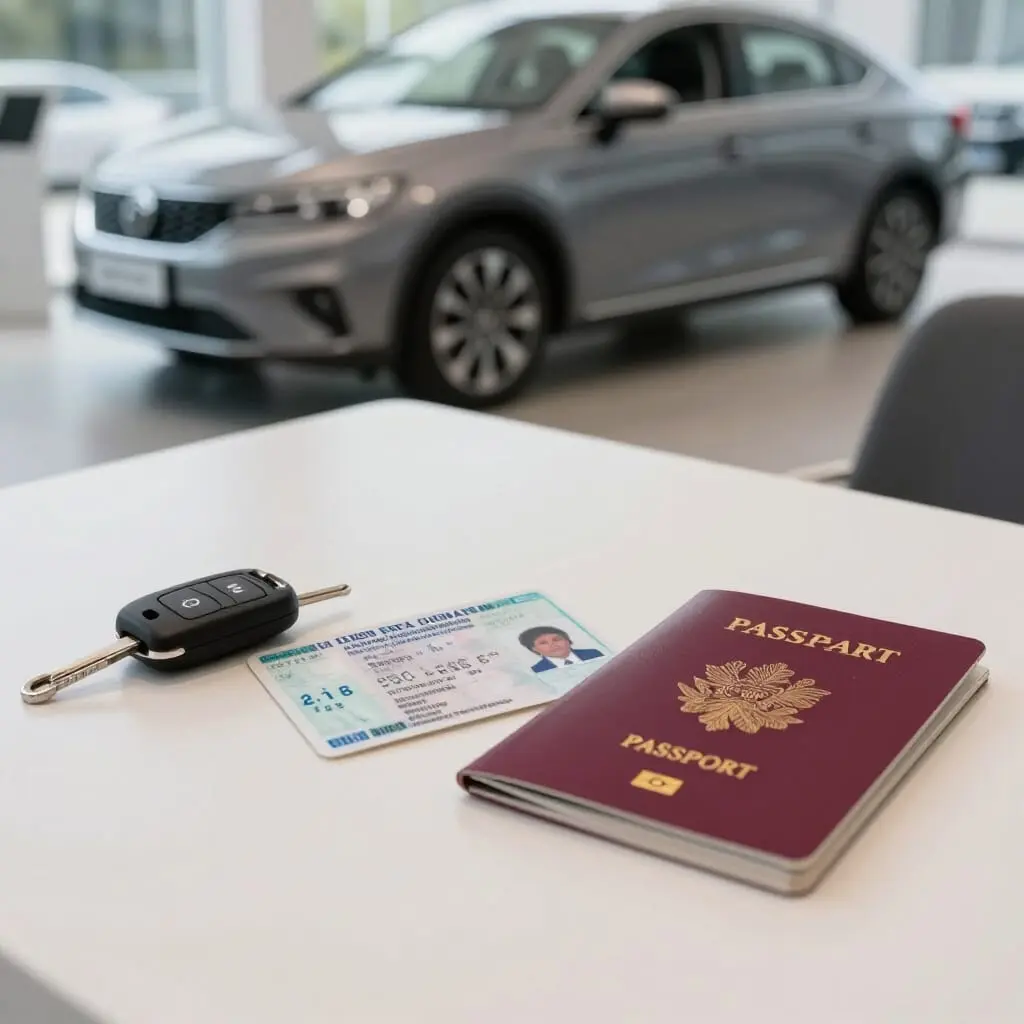
To rent a car, three documents are essential: a valid driver’s license, a valid identity document, and a credit card in the primary driver’s name. This is the standard requirement for all rental agencies, whether they are large international networks or small local businesses. However, depending on the context—standard agency rental, peer-to-peer rental, or renting as a sole trader/freelancer—the required documentation can vary significantly. This guide details every necessary document, special cases (young drivers, foreign licenses, additional drivers), and the mistakes that can cause your reservation to fail on the day of departure.
The Three Mandatory Documents at Rental Agencies
Regardless of the rental company you choose, three items will systematically be requested at the counter.
The driver’s license must be valid and, in the vast majority of agencies, must have been held for at least one year. For certain vehicle categories (vans, luxury cars, premium categories) or for young drivers, the required seniority often increases to 3 years. French licenses, European licenses, or international licenses are accepted depending on the country of rental—a point to verify before traveling abroad, as a license alone may not suffice outside the European Union; an International Driving Permit (IDP) may be required as a supplement.
The identity document—national ID card or passport—must be valid. An expired card, even by a few days, is grounds for immediate refusal at the counter, with no possibility of negotiation in most major networks.
The credit card is arguably the most misunderstood document by renters. It must imperatively be in the name of the primary driver—it is impossible to use a third party’s card, even if they are a spouse or parent. It usually needs to be a credit card (Visa or Mastercard), used both to pay for the rental and to secure the security deposit via a pre-authorization. Debit cards, prepaid cards, or virtual cards are frequently rejected because they do not allow for this hold on funds. This detail surprises many tourists who only discover the refusal once they arrive, even though their online reservation was confirmed without issue.
Special Cases: Young Drivers, Additional Drivers, and Foreign Licenses
Beyond the basic trio, certain renter profiles must provide additional documentation.
Young drivers, generally aged 21 to 25 depending on the agency, often must present a license held longer than the average renter and are frequently subject to “young driver fees” charged directly on-site. Some agencies also require proof of license seniority via a driving record provided by an insurer, especially when the issue date is not clearly visible on the license itself.
An additional driver, if included in the contract, must present the same documents as the primary driver: a valid license and identity document. They do not, however, need to provide a credit card unless they are sharing the rental costs. Failing to declare an additional driver at the time of signing usually invalidates insurance coverage in the event of an accident occurring while they are driving.
For foreign tourists, a national license is sufficient within the European Union, but an International Driving Permit (IDP) is often recommended, or even mandatory, outside the EU—notably in the United States, Japan, or certain Southeast Asian countries. This document, translated into multiple languages, also facilitates roadside checks. In France, it is issued by the prefecture upon presentation of the national license, and it never replaces the license itself: both documents must be presented together.
Finally, a proof of residence is sometimes requested for recent residents in a country, or when the address on the license differs from the billing address on the credit card.
Peer-to-Peer Car Rental: What Extra Documents Are Needed?
Peer-to-peer car rental, via dedicated platforms or direct agreements, operates under a less standardized framework than agencies, making certain documents even more critical.
A written rental contract is the centerpiece of the file. It specifies the rental duration, allowed mileage, deposit amount, return conditions, and the allocation of responsibility in case of damage. Without this contract, it becomes very difficult to assert your rights in the event of a dispute—a simple verbal agreement or an exchange of messages is not enough to protect both parties.
A copy of the vehicle registration (logbook/carte grise) allows the renter to verify that the person renting the car is indeed the owner (or has the authority to rent it). This is an essential point of vigilance, as several scams rely on renting a vehicle by someone who does not own it.
The insurance certificate covering the vehicle being provided for payment is the most often overlooked—and yet most critical—document. Most standard auto insurance policies do not cover renting a vehicle to a third party for money: the owner must have notified their insurer and obtained a coverage extension, or subscribed to specific insurance via the rental platform. A prudent renter systematically asks for this certificate before signing, as in the event of an accident without proper coverage, the costs could fall entirely on them.
The driver’s license and identity document are, of course, still required, as is a payment method for the security deposit, often settled by bank transfer or card imprint depending on the platform used.
Sole Traders and Professional Rentals
A sole trader (auto-entrepreneur) renting a vehicle as part of their business activity—for delivery, client travel, or transporting goods—may sometimes need to put together a different file than a private individual.
Some agencies offer “professional” deals requiring a certificate of incorporation (Kbis) or, for a sole trader, proof of SIRENE registration (SIRENE status notice). This document proves the legal existence of the business and allows for specific pricing or tax conditions, notably the recovery of VAT on the rental if the vehicle is used for professional purposes.
A professional bank account statement (RIB) or a credit card linked to the business account may be requested for billing, separately from the personal card used for the security deposit. This distinction prevents the mixing of professional and personal expenses, a practice often recommended by accountants to simplify expense reporting.
For renting a van for business use, some agencies also require a statement of mission purpose (the professional reason for the rental), especially when a negotiated professional rate is applied instead of the standard consumer rate.
In all cases, it is essential to check in advance with the agency which specific documents are expected for a professional rental, as these requirements vary greatly from one network to another and are not always clearly indicated during online booking.
Common Mistakes That Prevent You from Getting the Keys
Certain mistakes recur regularly and can turn a confirmed reservation into a flat refusal at the counter.
The most common involves an incompatible credit card: booking with a credit card and then showing up with a debit card, or vice versa. The name on the card must match exactly the name of the primary driver indicated on the reservation—a card in a spouse’s name, even on a joint account, is generally refused.
An insufficient credit card limit to cover the security deposit—which can reach several hundred or even over a thousand euros depending on the vehicle category—also blocks the handover of keys. It is recommended to check your limit with your bank before departure, especially for high-end vehicle rentals or during peak season.
Insufficient license seniority, particularly for young drivers or when renting certain vehicle categories, is another frequent reason for refusal, often discovered too late by the traveler.
Finally, failing to reserve an additional driver at the time of picking up the vehicle, even if they will actually be driving during the trip, exposes you to a lack of insurance coverage in case of an accident—a major financial risk that no tourist should take lightly. It is always better to anticipate the full list of necessary documents a few days before departure rather than discovering them at the counter.
What documents are needed to rent a car at an agency?
A valid driver’s license, a valid identity document, and a credit card in the primary driver’s name, typically a credit card that allows for a security deposit hold.
Can I rent a car with a debit card?
It is often refused because a debit card may not always allow for the security deposit to be blocked via pre-authorization. It is better to check the rental company’s terms before booking.
What documents are needed for peer-to-peer car rental?
A written rental contract, a copy of the vehicle registration, an insurance certificate covering the rental for profit, as well as the renter’s license and identity document.
Does a sole trader need to provide specific documents to rent a vehicle?
Yes, some agencies request a Kbis extract or a SIRENE status notice, as well as professional bank details for billing a professional rental.
How long must I have held my license to rent a car?
Generally at least 1 year, but some agencies require 3 years of seniority for young drivers or for certain vehicle categories.
Do I need an international permit to rent a car abroad?
Within the European Union, a national license is sufficient. Outside the EU, an International Driving Permit (IDP) is often recommended or even mandatory alongside your national license.
Does the additional driver need to provide a credit card?
No, they must present a valid license and identity document, but the credit card is only required from the primary driver, unless they are sharing the costs.
Which document proves that a peer-to-peer rental is insured?
The insurance certificate covering the vehicle being provided for compensation, which should be requested from the owner before signing the contract.
Sources
- Documents required to rent a car – Enterprise
- Papers to provide for a car rental – Vision Automobile
- Administrative procedures to rent a vehicle – MF Location
- Peer-to-peer car rental contract – Dennis Clare

À découvrir

Car Rental in Lyon: Complete Guide & 2026 Rates
Find the best car rental in Lyon. Compare rates, providers, and deals. Starting from €20/day. Airport, stations, and peer-to-peer options.

One-way car rental: How does it work?
November 16, 2026
Car rental for multiple drivers: rules and conditions
November 16, 2026