Driving in Paris: traffic, ZFE zones, parking, and practical tips
- The metropolitan ZFE (Low Emission Zone) restricts Crit’Air 3 and older diesel vehicles, but a grace period without fines lasts until the end of 2026.
- Since November 2024, a Limited Traffic Zone (ZTL) prohibits transit through central Paris: only trips starting or ending within the perimeter are allowed.
- On-street parking is paid from Monday to Saturday, but free on Sundays and public holidays in almost all arrondissements.
- Underground parking (Halles, Montmartre, Sully, Perrier…) offers flat rates that are often more advantageous than on-street parking for tourist stays.
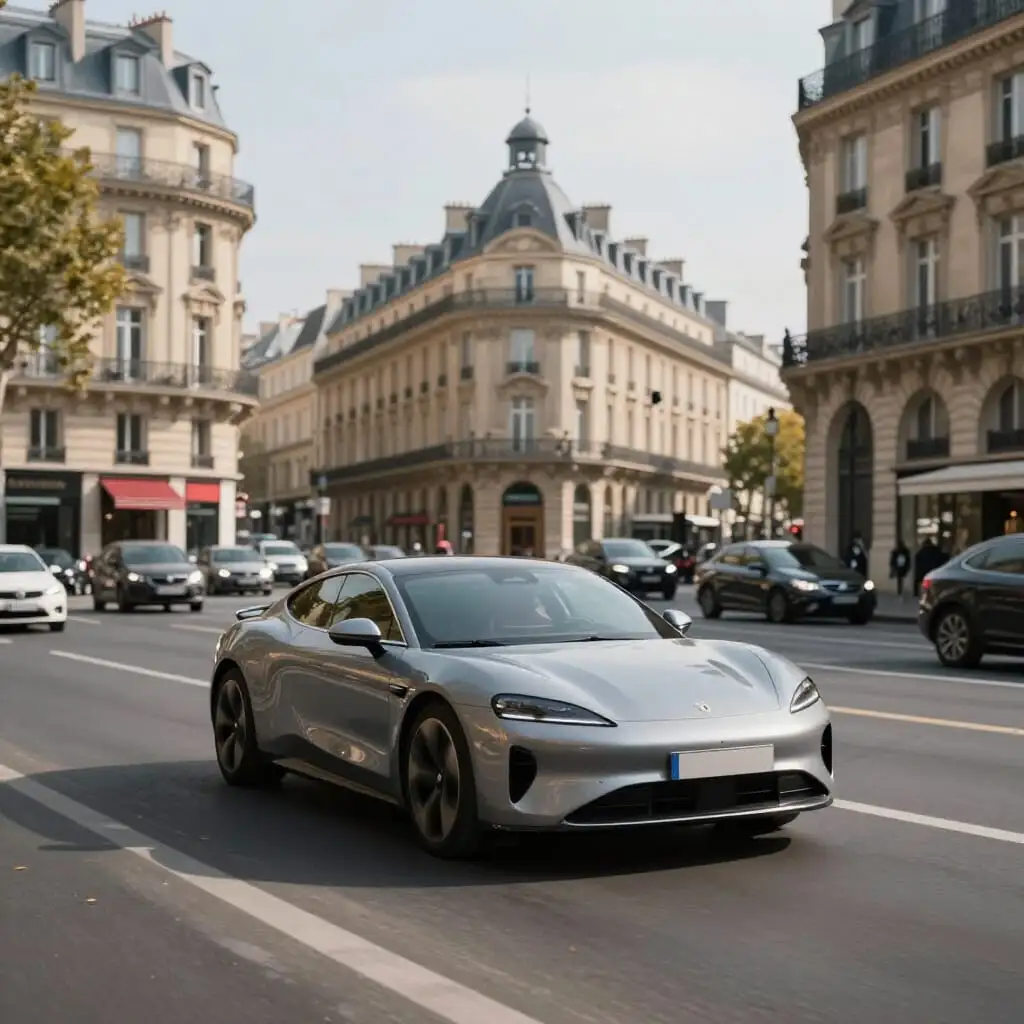
- Electric vehicles benefit from reduced rates and easier ZFE access, making them a great choice for city rentals.
Driving in Paris with a rental car raises three practical questions: am I allowed to drive this vehicle, where can I park, and how much will it cost? The answer depends on the engine type (petrol, diesel, electric), the vehicle’s age, and your destination neighborhood. Paris combines a Low Emission Zone (ZFE), a Limited Traffic Zone (ZTL) in the center, and paid on-street parking across nearly the entire city. This guide covers current traffic rules, Crit’Air stickers, specific rules for classic and electric cars, and the best parking solutions by neighborhood—such as Montmartre, Les Halles, the 16th arrondissement, Sully, or Perrier—to help you drive and park without any unpleasant surprises during your visit.
Understanding Paris traffic and its specifics
Paris was not designed for cars, and you will feel it from the very first few kilometers. The network is dense, one-way streets are numerous, and several major arteries (Boulevard Saint-Germain, Avenue des Champs-Élysées, Boulevard Sébastopol) concentrate most of the traffic during peak hours. For a tourist behind the wheel of a rental car, the challenge is not just finding your way, but anticipating recurring delays, particularly between 8:00 AM – 10:00 AM and 5:00 PM – 7:30 PM.
The Périphérique (ring road) remains the smoothest route to bypass the city rather than driving through it—a strategy often faster than cutting through the center, especially since the implementation of the Limited Traffic Zone. Real-time navigation tools (Waze, Mappy, or the local Sytadin service for Île-de-France) allow you to visualize traffic jams, roadworks, and temporary closures before you start, a vital habit as construction and nighttime closures are constantly evolving in the capital.
One point often underestimated by visitors: the riverbank lanes (voies sur berges), long used as relief routes, are now largely closed to car traffic or reserved for soft mobility (bikes/scooters) on the Left Bank. It is better to plan an alternative route rather than relying on these historic axes. Finally, the speed limit is 30 km/h (approx. 18 mph) on almost the entire Parisian network outside of major thoroughfares, which mechanically increases travel times compared to other large European cities—an element to integrate into your sightseeing schedule if you plan several car trips during the day.
ZFE, Crit’Air stickers, and diesel: what to check before driving
The metropolitan Low Emission Zone (ZFE) of Grand Paris has required a mandatory Crit’Air sticker, displayed on the windshield, for several years to drive within the perimeter covering Paris and much of the inner suburbs. This sticker classifies vehicles according to their emission levels, from Crit’Air 0 (electric) to Crit’Air 5 (the oldest and most polluting).
In practice, the situation for diesel vehicles has become stricter: the ZFE now includes restrictions targeting Crit’Air 3 vehicles, which affects many diesels registered before 2011. However, there is some reassurance for visiting drivers: the city has established a “grace period” without sanctions, running until the end of 2026. This means the rule exists on paper, but no automatic fines are applied during this transitional phase—a tolerance that does not, however, exempt you from displaying the Crit’Air sticker corresponding to your vehicle, as the requirement to display it remains in force.
For a tourist renting a vehicle on-site, the simplest approach is to check the Crit’Air class of the model offered by the rental agency before booking, especially if your stay includes regular trips to the city center. A recent petrol or hybrid car generally poses no problems (Crit’Air 1 or 2). On the other hand, an older diesel van rented for moving or transporting bulky luggage deserves a check, as rules can evolve year by year as the grace period nears its end. It is also advisable to order your Crit’Air sticker well in advance if the rental vehicle does not already have one, as it can take several days to receive.
The Limited Traffic Zone (ZTL) in central Paris
Since November 5, 2024, a new rule has changed the game for anyone crossing the capital by car: the Limited Traffic Zone (ZTL), implemented in central Paris. The principle is simple but significant: only vehicles whose journey begins or ends at an address within the perimeter are authorized to drive there. Transit traffic—that is, driving through this zone to reach another part of the city without stopping—is now prohibited.
For a driver coming from outside the city who simply wants to reach the Right Bank or Left Bank by cutting through the historic center, this restriction means rethinking their route and prioritizing peripheral axes. Conversely, if your hotel, rental car pick-up point, or destination is within the affected perimeter, access remains normal.
This measure primarily aims to reduce transit traffic and calm circulation in the densest tourist neighborhoods, an objective that aligns with air pollution concerns in urban traffic. Practically speaking, visitors planning to rent a car to visit Paris should check the exact boundaries of this zone before planning daily trips, or consider using public transport for the central part of their stay and reserving the car for excursions outside of Paris.
Electric cars in Paris: advantages for your tourist stay
Renting an electric vehicle to visit Paris offers several concrete advantages beyond the ecological argument. Classified as Crit’Air 0, these vehicles escape all ZFE-related restrictions and can circulate without any limitations, regardless of how diesel rules evolve in the coming years. It is a choice that secures your trip against potential regulatory tightening during the current grace period.
Parking is another advantage: several arrondissements apply reduced rates, or even partial free parking, for electric vehicles in certain on-street spaces equipped with charging stations, provided the vehicle is actually charging. The charging station network has also become much denser in the capital in recent years, with charging points accessible in many underground parking lots in the center, making it easier to recharge during a visit rather than searching for a dedicated station.
The main point of caution remains the actual driving range in urban use, which is often lower than the advertised figures in mixed cycles, especially during trips combining city driving with outings to the outskirts or the châteaux of Île-de-France. For a purely Parisian stay with few daily kilometers, this constraint is marginal. However, it becomes a key selection criterion if your itinerary includes one or more excursions outside the capital, where you will need to identify fast-charging stations along your route in advance.
Classic and collector cars: what are the rules in Paris?
Owners or renters of classic vehicles must navigate a specific framework. Collector vehicles, which have a registration document (carte grise) mentioning this status and are generally over thirty years old, benefit from an exemption to ZFE restrictions: they can drive within the perimeter despite their Crit’Air class, provided they can prove this status during a check. This exception aims to preserve heritage uses and automotive events, but it does not apply to a vehicle that is simply old without this specific administrative status.
For a more standard diesel or petrol vehicle registered before the thresholds set by Crit’Air 4 or 5 classes, driving in the ZFE is theoretically permanently prohibited, even outside of high-pollution peak periods. However, this is currently covered by the aforementioned grace period until the end of 2026. This tolerance does not, however, apply to “differentiated circulation” episodes triggered during pollution peaks, where reinforced and temporary restrictions may apply regardless of the usual ZFE calendar, with active enforcement by law enforcement.
For a tourist, this question rarely arises because professional rental companies regularly refresh their fleets and mostly offer recent vehicles classified as Crit’Air 1 or 2. The subject becomes relevant mainly for visitors importing their own classic vehicle from abroad or participating in a collector car rally in the capital—two cases where it is recommended to verify eligibility for the exemption before departure.
Parking in Paris: rates, residents, and on-street parking
On-street parking in Paris operates on an hourly pricing principle, payable via the Paris Zeta app or at parking meters, with rates varying by zone (center, dense tourist zones, peripheral arrondissements). Unlike some other major cities, Paris does not offer generalized courtesy free parking: payment is required from the very first minute of parking on weekdays and Saturdays in the vast majority of streets.
The good news for visitors: on-street parking is free on Sundays and public holidays in almost the entire city, allowing you to plan certain outings by car on those days without extra parking costs. However, it remains essential to check local signage, as certain specific zones (near highly frequented sites, reserved spaces) may deviate from this general rule.
Hourly parking rates vary significantly from one arrondissement to another: the most central and sought-after areas, such as certain sectors of the 16th arrondissement, generally apply rates near the ceiling authorized by the city hall, with the maximum allowed parking duration often limited to two consecutive hours in a single space in dense zones. For a tourist planning to stay several hours in one place, this limitation often makes underground parking more relevant than on-street parking, especially when you want a predictable parking budget for the duration of your stay rather than being subject to the uncertainty of mandatory vehicle relocation.
Parking garages: where to park by neighborhood
Given the pressure on on-street parking, underground garages are often the simplest solution for a tourist with a rental car, offering predictable flat rates and guaranteed availability upon arrival. The choice of parking depends primarily on the neighborhood you are visiting.
Near Les Halles, the local underground parking allows you to explore on foot towards the Centre Pompidou, the Marais, and Île de la Cité—a sector particularly dense with traffic where avoiding the search for surface parking saves precious time. In Montmartre, the parking lots at the foot of the hill provide a practical starting point to visit the Sacré-Cœur and the picturesque streets of the 18th arrondissement, a neighborhood where on-street parking is particularly rare due to the topography and constant tourist influx.
In the Marais and on Île Saint-Louis, the Sully parking lot provides direct access to the quays and Notre-Dame, while the Perrier parking, located further west, efficiently serves sectors near major shopping streets. For the 16th arrondissement, renowned for its high on-street parking rates, the area’s residential and commercial garages often offer a better price-to-duration ratio once parking exceeds two or three hours.
A useful tip for tourists: reserve your parking space in advance via a dedicated app. This not only guarantees a spot upon arrival but often provides a preferential rate compared to the hourly rate displayed on-site, especially for full-day parking or longer.
Sunday parking, public holidays, and delivery zones
Sunday is a notable exception in the Parisian parking landscape: the city applies free parking to almost all paid on-street spaces, an advantage to include in your planning if your stay includes this day of the week. Public holidays generally follow the same logic, although a few occasional exceptions may exist depending on the arrondissement, which justifies checking local signage before leaving your vehicle for several hours.
However, this Sunday free parking does not extend to private underground garages, which apply their usual rates seven days a week, nor to spaces specifically reserved for other uses (deliveries, persons with reduced mobility, taxis), which remain subject to their own rules regardless of the day.
Delivery bays, identifiable by specific ground markings, are reserved for vehicles loading or unloading goods, usually during specific time slots posted nearby. For a tourist in a rental car, these spots should be avoided, even for a few minutes of stopping, as they are subject to regular checks and parking there is charged at the highest rate in case of non-compliance. If you need to load bulky luggage upon arriving at your accommodation, it is better to opt for a very brief stop in a double-parking position if the street configuration allows it without obstructing traffic, rather than occupying a delivery bay reserved for professionals.
Practical tips for stress-free driving and parking
For a tourist renting a car in Paris, a few simple habits can prevent most inconveniences. First, systematically check the Crit’Air class of the rental vehicle and ensure the sticker is properly displayed on the windshield before hitting the road, even during the current grace period when checks are still possible despite the lack of automatic fines.
Next, prioritize underground parking whenever you need to park for more than two hours, reserving in advance if possible to secure both the rate and availability, rather than circling on-street looking for a spot in dense neighborhoods like Montmartre or Les Halles. For trips crossing several neighborhoods, keep in mind that the ZTL in the center now prohibits transit: taking a detour via the Périphérique or the major boulevards may prove faster than driving directly through the historic heart.
Finally, it is useful to consult real-time traffic tools before every departure, especially during peak hours. Reserve car trips for journeys where a vehicle provides a real advantage—such as excursions outside of Paris, transporting heavy luggage, or visiting peripheral sites poorly served by public transport—rather than for strictly intra-city trips, which are often faster by foot, bike, or metro given the traffic density and the scarcity of surface parking.
Can I still drive a diesel car in Paris in 2026?
Yes, under certain conditions. The ZFE officially restricts Crit’Air 3 and older diesel vehicles, but a grace period without sanctions applies until the end of 2026, except during pollution peak episodes where reinforced restrictions may apply.
Is parking free on Sundays in Paris?
Yes, paid on-street parking is free on Sundays and public holidays in almost all arrondissements, with the exception of private parking lots and spaces reserved for specific uses (delivery, disabled parking).
What is the Limited Traffic Zone (ZTL) in central Paris?
Since November 2024, the ZTL prohibits transit traffic in central Paris: only vehicles whose journey begins or ends at an address within the perimeter are allowed to drive there.
Can a rental electric car drive anywhere in Paris?
Yes. Classified as Crit’Air 0, they escape all ZFE restrictions and often benefit from reduced parking rates in spaces equipped with charging stations.
Where is it easy to park near Montmartre or Les Halles?
Underground parking in these two neighborhoods offers predictable flat rates and more reliable availability than on-street parking, which is particularly saturated in these busy sectors.
Can a classic car drive in the Paris ZFE?
Only vehicles with official collector status, as noted on their registration document (carte grise), benefit from a permanent exemption; other older vehicles are subject to the general ZFE rules.
How much does parking cost in the 16th arrondissement?
The hourly rate is among the highest in the capital; for stays longer than two or three hours, a local underground parking garage is often cheaper than on-street parking.
Can I stop in a delivery bay to unload my luggage?
No, these spots are reserved for professionals during specific time slots and are subject to regular checks; a brief stop outside a regulated space is preferable if the street allows it.
Sources
- City of Paris — Limited Traffic Zone (ZTL) in Central Paris
- City of Paris — Metropolitan Low Emission Zone (ZFE)
- ViaMichelin — Diesel vehicles in Paris in 2025
- Sytadin — Real-time traffic status in Île-de-France

À découvrir

Road Cracks & Bumps: Impact on Tires and Shock Absorbers
Learn how road cracks, potholes, and bumps damage your tires and suspension, and discover tips to protect your vehicle and ensure driving safety.

Route des Grandes Alpes: Complete Itinerary & Tips
November 9, 2026
Potholes: Why They Form & How to Repair Them
November 9, 2026