
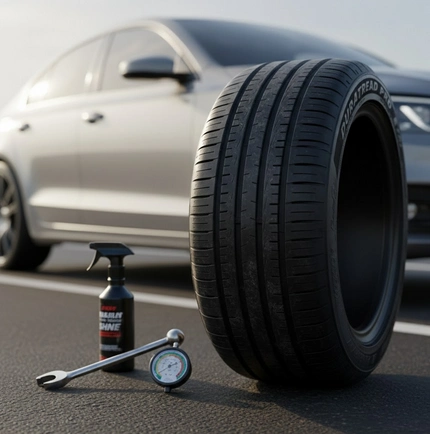
Tire Guide: How to Extend Their Lifespan (Cars, MTB, Tubeless)
- Correct pressure is the #1 factor: Monthly checks prevent premature wear and excessive fuel consumption.
- Tubeless maintenance (for both cars and MTBs) relies on monitoring sealant levels and ensuring rim seal integrity.
- Regular tire rotation and alignment checks distribute wear evenly and prevent the need for premature full-set replacements.
- Before driving a rental vehicle, a quick visual inspection (pressure, tread, bulges) helps avoid unpleasant surprises.
- The legal tread depth limit in France is 1.6 mm; tires must be replaced once they fall below this threshold.
A poorly maintained tire wears out two to three times faster than a well-maintained one—and the cause is almost always the same: neglected pressure. Whether you are driving a car, an MTB with tubeless tires, or behind the wheel of a rental vehicle for a holiday, the principles of tire maintenance remain the same: monitor pressure, distribute wear, protect the rubber from external damage, and react quickly to any sign of an anomaly. This guide details the practical steps to take based on tire type (standard or tubeless) and vehicle type, providing clear benchmarks to know when to take action and when to replace them.
Pressure: The Key Factor for Longevity
Tire pressure alone dictates a large portion of a tire’s lifespan. An under-inflated tire generates more heat, deforms at the sidewalls, and wears abnormally along the edges of the tread. Conversely, an over-inflated tire wears out the center of the tread faster and reduces grip, especially on wet roads. In both cases, the result is the same: premature replacement, often several months before the expected end of its life.
Checks should be performed on cold tires, ideally once a month and always before a long trip—a crucial tip for tourists driving rental vehicles, who often cover longer distances on unfamiliar roads. Reference values are usually found on a sticker inside the driver’s door or in the vehicle manual; these values vary depending on the load (empty vehicle, fully loaded, or towing a trailer).
For an MTB equipped with tubeless tires, the logic is similar, but the pressure ranges are much lower (often between 1.5 and 2.5 bar depending on the terrain), which improves traction while reducing the risk of pinch flats. However, pressure that is too low in a tubeless setup increases the risk of a “burp”—a sudden loss of air at the tire bead—and accelerates sidewall wear on rocky terrain.
Car Tire Maintenance: Rotation, Alignment, and Visual Inspection
Car tire maintenance is not limited to pressure. Tire rotation—swapping the positions between the front and rear (or diagonally depending on the vehicle configuration)—allows for the even distribution of wear, which is never identical across all four wheels. On front-wheel-drive cars, the front tires wear faster due to steering and traction; without rotation, the wear gap between the front and rear can become significant enough to force the replacement of an entire axle prematurely, which then creates issues with tread consistency between new and worn tires.
Wheel alignment (or geometry) also plays a major role. A poorly adjusted vehicle, often following a curb impact or hitting a pothole, causes irregular tire wear—such as a sawtooth pattern or wear on only one side—even when pressure is perfectly maintained. A professional inspection is recommended as soon as asymmetrical wear appears or after any notable impact.
Finally, regular visual inspection is the simplest yet most neglected task: look for bulges (sidewall deformities indicating internal damage), embedded objects in the tread, cracks caused by rubber aging, and check tread depth using the built-in wear indicators or a simple coin. Below 1.6 mm, the legal limit in France, the tire must be replaced immediately.
Tubeless Tire Maintenance: The Key Role of Sealant
Tubeless systems, whether on a car or an MTB, work without an inner tube: the seal relies on the rim-to-tire fit and, most often, on a liquid sealant injected inside that automatically plugs small punctures. Tubeless maintenance therefore differs from standard tube-type tires in one essential way: monitoring this liquid.
Sealant gradually dries out, especially in hot or dry climates, losing its ability to plug holes long before the tire visually appears flat. Regular checks (via the valve or by observing through the sidewall on semi-transparent tires) allow you to verify that it remains fluid and sufficient in quantity. If in doubt, it is better to top it up or replace the liquid rather than waiting for a puncture in the middle of a ride.
The second point of vigilance concerns the integrity of the seal itself: the rim tape must remain intact and properly positioned, without folds or peeling, to prevent slow leaks that require frequent re-inflation. A tubeless tire losing pressure over a few days without a visible puncture almost always signals a problem with the rim tape or the valve, or more rarely, porosity in the rubber itself.
MTB Tubeless Maintenance: Terrain and Usage Specifics
MTB tubeless maintenance adds constraints specific to the sport. Tubeless MTB tires are subject to repeated impacts (roots, rocks, rough terrain) that put heavy stress on the sidewalls, which are thinner than those of a car tire. After every intense ride, a quick check of the sidewalls and tread can spot deep cuts that the sealant may not be able to fix.
The frequency of sealant checks depends heavily on usage: a regular rider in a hot climate should check and potentially recharge the sealant every two to three months, compared to much longer intervals for occasional use in a temperate climate. A tubeless MTB tire left unused for a long time will also see its sealant dry out and form internal clumps (small latex balls), which must be removed during re-mounting to prevent wheel imbalance.
Cleaning after a muddy or sandy ride also contributes to longevity: sand, in particular, acts as an abrasive that accelerates rubber wear if left embedded in the knobs. A simple water rinse—avoiding high-pressure jets directed at the tire bead, which can compromise the seal—is generally sufficient.
Storage, Climate, and Rubber Aging
Even when not in use, tires age. Prolonged exposure to sunlight (UV rays) and ozone weakens the rubber and causes surface cracking, especially on the sidewalls. For vehicles used infrequently or stored for the winter, parking in the shade or under a cover limits this phenomenon.
Ambient temperature also directly influences pressure: a drop in temperature causes the internal pressure to fall, which is why checking tires after a significant seasonal change is particularly important. This is a key point to keep in mind for vehicle rentals in regions with contrasting climates, where a tire correctly inflated at the start may become under-inflated after a sudden nighttime temperature drop.
For removed and stored tires (summer/winter sets), storing them flat or hanging, away from heat sources, chemicals (oils, solvents), and direct light, preserves rubber flexibility much longer than outdoor stacking.
The Specific Case of Rental Vehicles
For a tourist renting a car, the question of tire maintenance is different: the goal is not to manage the lifespan over several years, but to ensure the vehicle is in good condition at the start and to know how to react if a problem occurs during the trip. A quick visual inspection upon pickup—tread depth, absence of bulges, and pressure consistent with the vehicle sticker—helps prevent being unfairly blamed for pre-existing wear or defects upon return.
On a tourist trip involving mountain roads, unpaved tracks, or long distances in high heat, pressure deserves a mid-trip check, especially if the vehicle is heavily loaded (luggage, sports equipment). Most rental companies recommend reporting any noticed anomaly immediately—vibration, irregular wear, or repeated pressure loss—rather than waiting until the end of the rental, which facilitates assistance in the event of a confirmed vehicle defect.
How often should I check my tire pressure?
A monthly check on cold tires is recommended for regular use, and you should always check before long trips or significant seasonal changes.
What is the legal tire wear limit in France?
The minimum legal tread depth is 1.6 mm across the entire circumference of the tire; below this, replacement is mandatory.
How do I maintain tubeless tires to avoid punctures?
You should regularly monitor the state and quantity of the sealant, check the integrity of the rim tape, and inspect the sidewalls after every intense ride.
Should I refill the sealant in an MTB tubeless tire?
Yes, sealant gradually dries out, especially in hot climates; a check every two to three months is advised for regular riding.
Why should I rotate my car tires?
Rotation distributes wear between the front and rear, preventing one axle from wearing much faster than the other and needing isolated replacement.
How can I check the condition of a rental vehicle’s tires before leaving?
A quick visual check of the tread depth, the absence of bulges or cuts, and the pressure compared to the vehicle sticker is sufficient before hitting the road.
Why does tire pressure drop when it gets cold?
Internal tire pressure decreases mechanically as the ambient temperature drops, which is why a check is necessary after a notable change in climate.
Where should I store removed tires to preserve their lifespan?
Store them flat or hanging, away from direct light, heat, and chemicals, to limit rubber aging.
Sources
- Vélosphère — How to maintain tubeless tires
- Véloshop — Easy maintenance for bicycle tubeless tires
- Magasins2vélo — How to maintain tubeless tires to make them last longer

À découvrir
Electric Car Accessories: Essential Gear for EV Owners
Discover the most essential accessories for your electric vehicle: charging cables, adapters, battery protection, and more to optimize your driving.

2026 Electric Car: How to Reduce Charging Costs
October 30, 2026
Car Rental Trends: The 4th Industrial Revolution
October 28, 2026