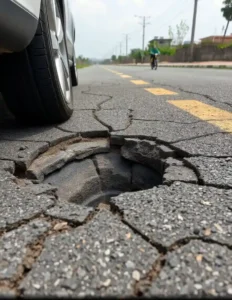

🛣️ How Road Cracks and Deformations Affect Your Tires and Shock Absorbers
Driving on damaged roads isn’t just uncomfortable: it can seriously damage your vehicle.
Cracks, potholes, and asphalt deformations directly impact tires and shock absorbers, leading to high repair costs and increased safety risks.
1️⃣ Types of Road Deformations and Cracks

Linear Cracks
- They appear as long, narrow slits.
- Often caused by freeze/thaw cycles, asphalt fatigue, or heavy traffic.
- Hard to see at night, they can cause micro-shocks to your tires and suspension.
Potholes
- Circular cavities caused by asphalt sinking.
- Repeated impacts can deform your rims, puncture your tires, and wear out your shock absorbers.
Longitudinal or Transverse Deformations
- Bumps, waves, or dips along the road.
- Often linked to poor water drainage or ground movement.
- These irregularities cause repeated jolts, accelerating mechanical fatigue in the suspension.
2️⃣ Effects on Tires
Premature Wear
- Cracks and deformations create uneven contact with the ground.
- Result: non-uniform wear, the appearance of flat spots on the tires, and loss of grip.
Risk of Punctures or Blowouts
- The sharp edges of cracks or potholes can pierce the tire sidewall.
- Significant deformation or a violent impact can cause a high-speed blowout, which is extremely dangerous.
Tire Deformation
- Repeated shocks can alter the tire’s shape, leading to vibrations and loss of comfort.
- This can also affect steering and handling, especially on winding or wet roads.

3️⃣ Effects on Shock Absorbers and Suspension

Shock Absorber Fatigue
- Every jolt from a crack or pothole stresses the springs and shock absorbers.
- Premature wear reduces shock absorption, making the ride stiffer and more dangerous.
Damage to Other Suspension Components
- Ball joints, control arms, stabilizer bars, and bushings can deteriorate more quickly.
- Consequence: costly repairs and a decrease in the vehicle’s active safety.
Impact on Comfort and Safety
- A weakened suspension leads to:
- Increased body roll during turns
- Longer braking distances
- Vibrations felt in the steering wheel and seat
The combination of worn tires and shock absorbers drastically reduces handling and stability, especially at high speeds or on wet roads.
4️⃣ How to Minimize Damage
Adjust Your Speed
- Driving slowly on degraded roads reduces the impact on tires and suspension.
- Even slowing down by 10 km/h can extend the lifespan of your equipment.
Tire Choice
- Check tire pressure and tread wear every 2 to 3 weeks.
- Have your shock absorbers and suspension inspected by a professional at least once a year.
Regular Checks
- Tires with reinforced sidewalls or higher speed ratings may absorb shocks better.
- All-season or heavy-duty tires designed for rough roads offer more durability and safety.
Road Repair
- Cracked or deformed roads should be repaired by paving professionals.
5️⃣ Signs Your Tires or Shock Absorbers Are Damaged

Here are a few unmistakable signs:
Vibrations in the steering wheel or seats
Unusual noises when hitting bumps
Uneven tire wear
Imprecise or unstable steering
Longer braking distances
Identifying these signs early helps prevent costly repairs and avoid accidents.
6️⃣ Conclusion
Driving on damaged roads directly impacts tires and shock absorbers, reducing both safety and comfort.
Practicing cautious driving, performing regular vehicle maintenance, and calling on professionals for road repair and maintenance is essential.

À découvrir

What to Do in Lyon in 2 Days? Complete Family Itinerary
Discover our complete 2-day Lyon itinerary: Old Lyon, Fourvière, Croix-Rousse, and family activities. Includes budget tips, practical advice, and local gems.

Paris Itineraries: Best Routes, Walks & Getaways
November 3, 2026
Best excursions around Paris by car: 12 great ideas
November 18, 2026