
Engine Oil Change: When and How to Do It?
- Engine oil changes are generally required every 10,000 to 20,000 km or once a year, depending on the engine type and fuel.
- The cost of a car oil change typically ranges from €60 to €150, depending on the vehicle, the oil chosen, and the service provider.
- The suction method is faster but less thorough than the traditional drain plug method.
- Automatic transmissions (EAT6, EAT8, DSG, 9G-Tronic) have specific service intervals that owners often overlook.
- Electric vehicles do not require engine oil changes but do need coolant and reduction gear maintenance.
Performing an engine oil change at the right time ensures your engine lasts longer and maintains better fuel efficiency. The short answer: for a modern petrol car, plan for a change every 15,000 to 20,000 km or once a year; for diesel, aim for every 10,000 to 15,000 km; and for automatic gearboxes, there is a specific interval—often forgotten—ranging from 60,000 to 100,000 km. The average cost for a car oil change is between €60 and €150, depending on the oil type (mineral, semi-synthetic, or fully synthetic) and the vehicle model. This guide details frequencies by engine and gearbox type, various methods (traditional drain plug vs. suction), steps for doing it yourself, and the specific needs of microcars, hybrids, and electric vehicles.
What is an engine oil change and why do it?
An engine oil change involves replacing used engine oil with fresh oil, along with a new oil filter. Engine oil serves three essential roles: lubricating moving mechanical parts, dissipating heat produced by combustion, and transporting impurities (such as metal particles and combustion residues) to the filter. Over time, oil loses its lubricating properties: it oxidizes, becomes saturated with particles, and becomes less effective at protecting internal engine components (pistons, crankshaft, camshaft).
Delaying an oil change beyond the recommended interval accelerates engine wear, leads to turbocharger clogging in turbocharged engines, and can, in extreme cases, cause engine seizure. Conversely, changing the oil too frequently offers no additional benefit and is simply an unnecessary expense. The goal is to respect the manufacturer’s recommended interval, found in the vehicle’s service manual, rather than following a generic rule that applies to all engines.
Regular engine maintenance is not limited to oil changes; it also includes checking coolant levels, inspecting the timing belt, and replacing filters (air, cabin, and fuel). Nevertheless, the oil change remains the most frequent and critical operation for the longevity of the engine block.
When to change oil according to engine type
The frequency of an oil change depends directly on the fuel type and engine design. For petrol engine maintenance, the standard interval is between 15,000 and 20,000 km, or once a year if annual mileage is low. Modern petrol engines, which are often turbocharged and use direct injection, are less tolerant of exceeding these intervals because the heat generated by the turbo degrades the oil more quickly.
For diesel engine maintenance, the interval is generally shorter, between 10,000 and 15,000 km, because diesel combustion generates more soot and carbon residue. Diesel engines equipped with a Diesel Particulate Filter (DPF) also require specific “low SAPS” oil to prevent clogging the filter.
Drivers who primarily drive in urban areas, making short trips where the engine never reaches its optimal operating temperature, should shorten these intervals: condensation and combustion residues accumulate faster in the oil when the engine runs cold. Conversely, primarily highway driving may allow you to reach the upper limit of the manufacturer’s interval.
In all cases, two indicators take precedence over general averages: the service light displayed on your dashboard and the date indicated in the service manual, which accounts for both mileage and the time elapsed since the last change.
Automatic gearbox oil change: a frequently forgotten task
Contrary to popular belief, an automatic transmission is not “lifetime” and also requires regular changes of its specific fluid (ATF). Many drivers wonder when to change automatic gearbox oil: the interval varies greatly depending on the type of transmission, generally between 60,000 and 100,000 km, though some manufacturers recommend a check as early as 60,000 km for heavy use.
On models frequently mentioned by owners, such as the Peugeot 2008 or Peugeot 3008 equipped with EAT6 or EAT8 gearboxes, or the Peugeot 308 with the EAT6, manufacturers generally recommend a change around 60,000 to 80,000 km, especially if the vehicle is used heavily in cities with frequent stop-and-go traffic. For the 9G-Tronic gearbox found in certain Mercedes models, the recommended interval is most often between 60,000 and 100,000 km depending on usage and the model year.
Manual gearbox oil changes follow a different rhythm: manual transmission fluid degrades more slowly, and the recommended interval is usually around 60,000 to 100,000 km, or even longer depending on manufacturer guidelines.
Neglecting automatic transmission fluid changes often results in jerking during gear shifts, slower response times, or even costly mechanical failures. This is a maintenance item that should not be confused with a standard engine oil change: the two operations are independent and performed at different intervals.
Hot or cold oil change: the best practice
The question of whether to change car oil while the engine is hot or cold comes up often, and the technical answer is clear: you should change the oil when the engine is warm—never cold, but never scalding hot either. Cold oil is more viscous and flows slowly out of the pan, which leaves residues at the bottom and unnecessarily extends the job. On the other hand, oil that is too hot poses a significant burn risk when handling the drain plug or the filter.
The recommended method is to run the engine for a few minutes before starting, or to perform the service shortly after a drive, once the engine has cooled enough to be handled safely but remains warm enough for the oil to flow easily. This is the standard practice in professional service centers: the vehicle is briefly started before being lifted on a hoist.
Drain plug vs. suction: which method to choose?
Two methods exist for changing engine oil: the traditional drain plug method and the suction method.
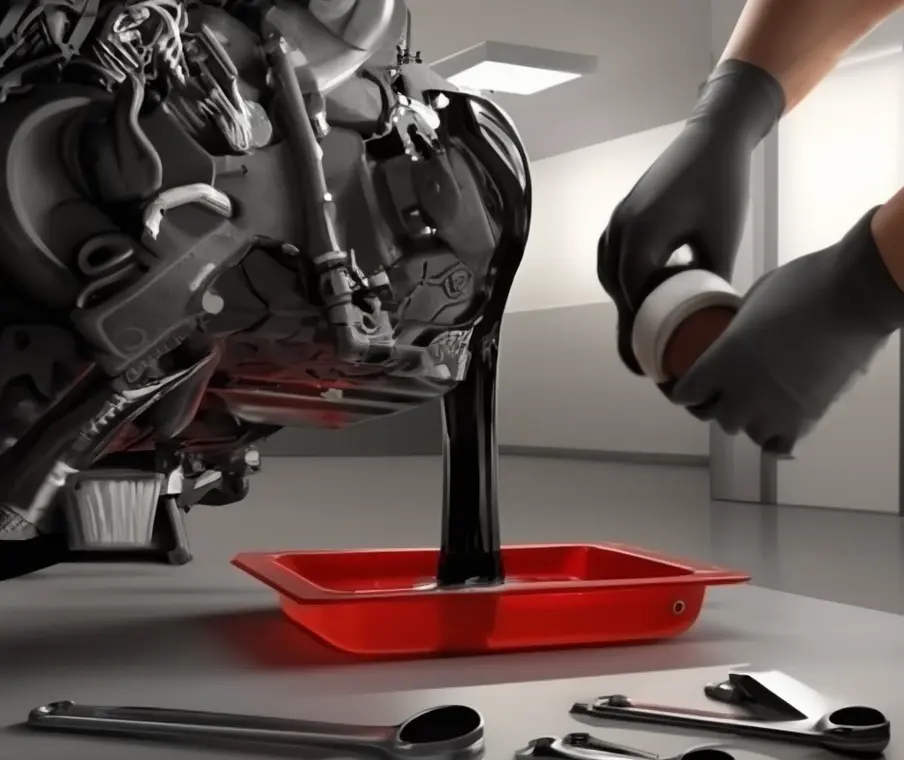
The drain plug method remains the industry standard. It involves unscrewing the plug located under the oil pan to let the used oil drain by gravity into a collection pan, then replacing the oil filter and refilling with new oil. This method has the advantage of draining almost all the oil from the pan, including the sludge that accumulates at the bottom.
The suction method is performed through the dipstick tube using a pump that draws the oil from the top of the engine, without needing to lift the vehicle or remove the drain plug. This method is faster and more convenient for garages handling a high volume of vehicles, but it generally leaves a small amount of residual oil and deposits in the pan, making it slightly less thorough than a gravity drain. Some DIY enthusiasts equipped with a suction pump also use this method to work on their own vehicles without needing to jack them up.
For routine maintenance, both methods are acceptable. For an older or very dirty engine, the drain plug method is preferable because it better removes the deposits accumulated at the bottom of the pan.
Doing an oil change yourself: steps and equipment
Performing an oil change yourself is possible on most vehicles, including microcars, provided you have the right equipment: an oil drain pan, a wrench suitable for the drain plug, a cloth, a new oil filter, a filter wrench if necessary, and a sufficient quantity of the manufacturer-recommended oil.
The basic steps are as follows: slightly warm the engine, position the vehicle on a flat surface with the front wheels chocked, place the pan under the drain plug, unscrew the plug to let the oil drain completely, replace the drain plug washer and the oil filter, screw the plug back in to the recommended torque, and then refill with new oil up to the level indicated on the dipstick. You should then run the engine for a few minutes, check for leaks, and then re-check the level once the engine has been turned off and cooled down.
For a microcar oil change, the principle is the same, but the engines involved—often single-cylinder diesel blocks from brands like Kubota, Lombardini, or Yanmar—require smaller quantities of oil and sometimes offer more restricted access. The recommended frequency is also tighter, generally around 5,000 to 10,000 km, due to the continuous high load on these small engines.
Used oil must never be thrown into drains or out in nature: it must be taken to a collection point, a recycling center, or a garage equipped with a recovery tank, as it is a regulated hazardous waste.
Cost of a car engine oil change
The price of a car oil change depends on three main factors: the type of oil used, the vehicle model (oil quantity and complexity of filter access), and the service provider. At general automotive service centers, an oil change including a filter replacement starts around €60 to €80 for entry-level oil and can go up to €150 for high-end fully synthetic oil on a modern engine requiring a large volume.
Dealerships generally charge higher rates, justified by the systematic use of manufacturer-approved oil and labor billed at the brand’s standard rates. Doing the oil change yourself can significantly reduce the bill, as you only pay for the oil and the filter, but it requires the proper tools and a basic level of mechanical skill.
In addition to the engine oil change cost, for applicable vehicles, there is the cost of the automatic transmission fluid change, which is generally more expensive due to the specific volume of fluid required and sometimes the need to reprogram the transmission’s adaptive settings after the operation.
Electric and hybrid engine maintenance: no traditional oil change
An electric car does not have an internal combustion engine and therefore has no engine oil to change: the electric motor does not have moving parts that require comparable lubrication. Electric vehicle maintenance focuses on other points: battery and power electronics coolant, reduction gear oil (it has only one gear, but it is lubricated), brake pads (which are often less used thanks to regenerative braking), and periodic high-voltage battery checks.
On a hybrid vehicle, however, the combustion engine still requires a traditional oil change, generally following an interval similar to an equivalent petrol engine, as it continues to operate intermittently. Therefore, engine oil changes remain relevant for hybrids, unlike 100% electric vehicles.
Other “changes” not to be confused
The term “vidange” (change/emptying) also applies to other equipment unrelated to a car engine, which can sometimes cause confusion in search queries. Septic tank emptying concerns the non-collective sanitation system of a home and must generally be carried out every four years, depending on the volume of sludge accumulated, by a certified company. Motorcycle oil changes follow a logic similar to cars, with an often shorter interval, between 5,000 and 10,000 km depending on the model and oil type, due to the higher engine RPMs of motorcycles.
These operations have no technical link to a car’s engine oil change, but they share the same principle: replacing a used fluid to preserve the proper functioning of a system.
When should I change the oil in a petrol car?
Generally every 15,000 to 20,000 km or once a year, depending on annual mileage and usage type (city or highway).
When should I change the oil in a diesel car?
More frequently, every 10,000 to 15,000 km, as diesel combustion causes oil to become dirty faster than in a petrol engine.
When should I change automatic gearbox oil?
Most often between 60,000 and 100,000 km depending on the gearbox type (EAT6, EAT8, DSG, 9G-Tronic); check your vehicle’s service manual.
Should I change the oil when the engine is hot or cold?
Neither completely cold nor scalding hot: a warm engine, after running for a few minutes, allows the oil to flow easily without the risk of burns.
What is the difference between the drain plug method and the suction method?
The drain plug method empties the oil via gravity and removes deposits more effectively, while the suction method uses the dipstick tube; it is faster but slightly less thorough.
How much does a car engine oil change cost?
Expect to pay between €60 and €150 depending on the oil type, vehicle model, and provider (service center, dealership, or DIY).
Does an electric car need an oil change?
No, the electric motor has no oil to change, but the coolant and the reduction gear oil require periodic maintenance.
When should I change the oil in a microcar?
Generally every 5,000 to 10,000 km, as these small diesel engines are under higher stress and require more frequent maintenance.
Sources
- Autodoc — oil change frequency, quantity, and procedure
- Speedy — car oil change prices and packages
- APS Automotive — engine oil change advice and frequency
- Euromaster — oil and filter change rates
- VS Pièces — microcar oil change guide

À découvrir

🚗Car Accessories: 2026 Guide & Top Essentials
Explore the 2026 car accessories guide with top safety, comfort, and tech picks to upgrade your vehicle safely and conveniently.

Probationary License: Essential Rules and Restrictions
November 5, 2026
Car Rental Trends: The 4th Industrial Revolution
October 28, 2026